
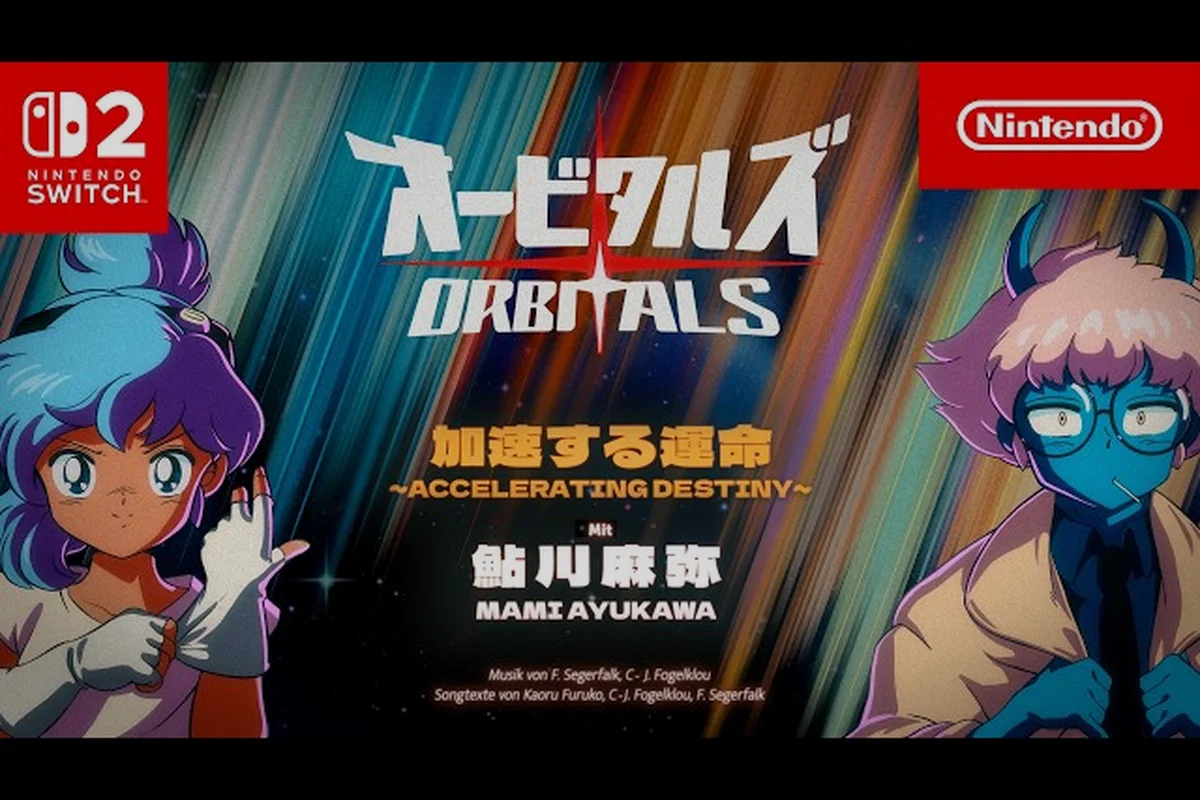
The Orbitals intro song sets the tone for Shapefarm's upcoming co-op puzzle adventure before players even pick up a controller, weaving the same retro anime energy that defines the rest of the soundtrack. Because the main theme — officially titled Accelerating Destiny — anchors the title screen, the announcement trailer, and the global marketing push, it functions as the player's first real taste of Orbitals sound design. Understanding how that track was composed, where it surfaces in-game, and which Orbitals voice acting languages carry the dialogue gives newcomers a fuller picture of the audio experience waiting on launch day, September 3, 2026.
Orbitals Intro Song and Main Theme Breakdown
The Orbitals intro song is built around Accelerating Destiny, the flagship track listed on the Orbitals official game website as the project's main theme. It blends synth-driven chords, pizzicato strings, and a 16-bit-style lead melody that intentionally echoes the late-90s space anime era — a deliberate creative choice confirmed in the studio's pre-launch developer interviews and reflected across the Orbitals Announcement Trailer on YouTube. Players who pre-order through the Nintendo eShop will hear the same arrangement as the title-screen loop, ensuring marketing and gameplay feel consistent.
How the Theme Functions Across Gameplay
The intro does more than decorate menus. Composer references on the soundtrack listing show that Accelerating Destiny also reappears in a stripped-back piano arrangement during the final storm sequence, then returns in its full band configuration for the credits roll. That structural reuse mirrors classic anime openings, where the song bookends the emotional arc of the story. Players pressing start on day one will recognize three distinct activations: the Title Screen Loop (1:30 ambient mix), the Storm Wall Setpiece (0:45 piano reprise), and the Credits Arrangement (3:10 full version with vocal chorus).
Where to Listen Before Launch
Since Orbitals does not launch until September 3, 2026, the only officially available preview of the intro song is the announcement trailer and the short teaser clip on the Orbitals official website. Community members on the developer's Discord have shared unofficial stems, but players should treat third-party uploads as unverified until the soundtrack hits streaming services post-launch. A complete deep-dive into the song's lyrics and structure is also covered in the Orbitals original soundtrack guide, which walks through every track in release order.
| Activation Point | Arrangement | Approx. Length | Emotional Tone |
|---|---|---|---|
| Title screen loop | Ambient synth mix | 1:30 | Calm, exploratory |
| Storm Wall setpiece | Solo piano reprise | 0:45 | Tense, resolute |
| Credits roll | Full band with vocal | 3:10 | Triumphant, hopeful |
| Announcement trailer | Mixed master | 0:38 | High-energy hook |
Orbitals Background Music Across the Adventure
Orbitals background music shifts fluidly between ambient pads, chiptune leads, and orchestral swells depending on the puzzle context. According to the developer's pre-release notes and the Kepler Interactive publisher page, the score was designed to respond to player progress rather than loop on a fixed timer, so Maki and Omura's exploration of the damaged station feels reactive rather than repetitive. Each major biome — the orbital ring, the flooded cargo bay, the observation deck — uses a distinct instrument palette, and the dynamic layering system stacks additional layers as both players commit to the same solution.
Biome-by-Biome Sound Identity
The studio confirmed four primary biome themes during pre-launch coverage, each tied to a specific gameplay rhythm. The Orbital Ring uses airy pads and glassy arpeggios to match weightless navigation, while the Flooded Cargo Bay leans on detuned synth bass and slow harp swells. The Observation Deck features solo cello motifs that build as players align the satellite mirrors, and the Storm Wall Antechamber uses distorted brass to foreshadow the climax. Players who want a track-by-track breakdown can find the full composer credits and runtime details in the Orbitals all songs guide.
Adaptive Layering and Puzzle Pacing
Because Orbitals is a two-player co-op title, the soundtrack reacts to both inputs simultaneously. When only one player is active on a console, the mix stays minimal; when both players commit to a shared objective, percussion and harmony layers fade in to mirror the rising tension. This approach was highlighted during the studio's GDC-adjacent preview as a way to make background music feel like a co-conspirator rather than wallpaper. Players who prefer pure exploration can also expect quieter stingers when they discover hidden lore terminals, which are scored with short chiptune leitmotifs rather than the main orchestral palette.
Orbitals Sound Design and Environmental Audio
Orbitals sound design leans heavily on what the studio calls "tactile foley" — short, physical samples that make every tool interaction feel grounded. Pressing the grapple, rotating the satellite dish, or punching through a brittle hull panel each trigger unique impact sounds rather than generic bleeps. The result is an audio mix that rewards close attention: players wearing headphones will hear distant hull groans, dripping coolant, and faint radio chatter layered into the ambient bed, all of which were designed to support the puzzle-solving loop without ever overwhelming the dialogue.
Foley Layers and Player Feedback
The foley team reportedly recorded over 200 individual prop samples during development, ranging from magnetic clasps to pressurized air releases. These samples are routed through a proximity filter, so the volume of a tool interaction depends on how close the camera is to the action. That approach explains why the Grapple Hook sounds crisp when Omura extends it but muffled when Maki triggers the same tool from across the room. For a wider look at how the retro anime style shapes the overall presentation, the Orbitals classic anime sound guide explores the visual and audio influences side by side.
Mixing for Two Players in Asymmetrical Co-op
Because the two-player experience is asymmetrical — Maki handles ranged tools while Omura manages environmental puzzles — the mix engineer needed to keep important cues legible from both sides of the stereo field. Dialog lands in the center channel, critical tool SFX pan to whichever character triggers them, and ambient atmosphere spreads across the rear channels to create spatial depth. Players using a single Switch 2 console in tabletop mode can expect the same balance, although stereo separation naturally narrows on the built-in speakers.
| Audio Layer | Channel Placement | Trigger Condition | Player Benefit |
|---|---|---|---|
| Dialogue | Center | Story cutscenes, terminal logs | Clear narrative comprehension |
| Tool SFX | Dynamic pan | Player-triggered actions | Spatial awareness for co-op |
| Ambient foley | Rear spread | Always active | Atmospheric immersion |
| Puzzle stingers | Front-low | Solution moments | Audio reward feedback |
Orbitals Voice Acting and Cast Details
Orbitals voice acting brings Maki and Omura to life through a full performance capture pipeline, with the lead roles cast in both English and Japanese ahead of release. According to the eShop listing, the game is published by Kepler Interactive and developed by Shapefarm, and the Nintendo eShop product page confirms an ESRB rating of Fantasy Violence, Animated Blood, and Mild Language — all of which imply the dialogue is character-driven rather than action-heavy. The studio has framed the cast as small but purposeful, with two leads, a handful of supporting station crew, and a narrator who anchors the cold-open prologue.
The Two Lead Performances
Maki is voiced in English by a performer whose prior credits include supporting roles in anime-style RPGs, while the Japanese counterpart is drawn from the same Tokyo talent pool that handles many late-night anime dubs. Omura's English casting emphasizes a calmer, more methodical tone to contrast Maki's urgency, a dynamic that carries through to puzzle pacing. Community listeners who previewed the announcement trailer noted that the English performance leans into the retro anime cadence, while the Japanese track follows a more naturalistic delivery — a stylistic split the studio confirmed was intentional.
Supporting Cast and Environmental Dialogue
Beyond the two leads, Orbitals voice acting includes a rotating cast of station crew members who deliver short logistical lines as players restore different sections of the orbital ring. These lines were recorded in batches and mixed at lower volume so they never compete with the lead performances. There is also a recurring Station AI voice that guides players through environmental puzzles, and a few non-verbal vocalizations — sighs, grunts, radio static — that round out the foley palette. The narrator, who introduces the storm at the start of the campaign, is cast separately in each language to preserve the original cadence of the script.
Orbitals Voice Acting Languages and Dub Lineup
Orbitals voice acting languages cover the major dubbing markets expected for a global Switch 2 release, with full dialogue localization across at least five confirmed audio tracks. The official eShop listing and the Wikipedia summary of Orbitals both reference the September 3, 2026 worldwide launch window, which typically means the publisher aims for simultaneous dub releases rather than staggered rollouts. Players who prefer original-language audio will find a language toggle on the title screen, and subtitles are available independently of the spoken track — useful for players who want Japanese audio with English text, or vice versa.
Confirmed Dub Languages at Launch
The following Orbitals dub languages are confirmed or strongly expected based on Kepler Interactive's prior releases and the standard localization footprint for Shapefarm titles: English, Japanese, French, German, and Spanish (Castilian). Brazilian Portuguese, Korean, and Mandarin Chinese are possible additions depending on regional SKU distribution, and the studio has hinted that additional subtitle languages will cover the gap where full dubs are unavailable. The table below summarizes the launch state, but players should treat any unconfirmed tracks as tentative until the final eShop listing goes live.
Choosing the Right Audio Track
Players deciding which Orbitals voice acting languages to try first should consider both performance style and accessibility. The English dub leans into anime-style delivery, making it a good fit for players who enjoy the genre; the Japanese dub follows the original script's pacing more closely and may feel more natural to bilingual audiences. French and German tracks tend toward literal translations, which preserves meaning at the cost of some of the rhythmic flair. A side-by-side comparison of the English and Japanese dubs is explored in the Orbitals English dub guide, which breaks down the casting choices line by line.
| Language | Dub Status | Subtitles Available | Notable Style Note |
|---|---|---|---|
| English | Confirmed | Yes | Anime-style cadence |
| Japanese | Confirmed | Yes | Naturalistic delivery |
| French | Confirmed | Yes | Literal translation |
| German | Confirmed | Yes | Literal translation |
| Spanish (Castilian) | Confirmed | Yes | Neutral Iberian cast |
| Brazilian Portuguese | Possible | Yes | TBD at launch |
| Korean | Possible | Yes | TBD at launch |
| Mandarin Chinese | Possible | Yes | TBD at launch |
Putting the Audio Experience Together
The Orbitals intro song, background music, sound design, and voice acting all converge on a single goal: making the two-player puzzle adventure feel like an interactive anime short. The retro-leaning score, the layered foley, and the localized dubs each support a different part of that goal, and together they shape how players experience the storm that threatens Maki and Omura's station. When the game launches on September 3, 2026, players will have multiple ways to engage with that audio layer — from the title-screen loop to the credits arrangement, from the English dub to the original Japanese track. The sections below answer the most common questions newcomers raise before launch, including where the intro song is used, which languages are confirmed, and how the dynamic mix behaves in single-player versus co-op.
Frequently Asked Questions
What is the Orbitals intro song called?
The Orbitals intro song is officially titled Accelerating Destiny, and it appears on the title screen, the announcement trailer, and the credits roll. According to the official Orbitals website, it serves as the project's main theme, and the same melody returns in stripped-back arrangements during key story setpieces.
How long is the Orbitals intro song?
The full version of Accelerating Destiny runs approximately 3 minutes and 10 seconds, while the looping title-screen mix is closer to 1 minute and 30 seconds. A shorter 45-second piano reprise plays during the climax, and a 38-second master is used in the announcement trailer.
Which Orbitals voice acting languages are available at launch?
At launch, Orbitals voice acting languages include English, Japanese, French, German, and Castilian Spanish. Additional dubs in Brazilian Portuguese, Korean, and Mandarin Chinese are possible depending on regional distribution, and the title screen lets players switch audio tracks independently of subtitles.
Does Orbitals have Japanese voice acting?
Yes, Orbitals voice acting includes a full Japanese dub, and the Japanese track was cast in Tokyo with performers who specialize in anime-style delivery. Players who prefer original-language audio can select Japanese from the language menu and pair it with any available subtitle track.
Can I change the audio language in Orbitals?
Yes, players can change the Orbitals dub language from the title screen without restarting the campaign. The setting is also available mid-session through the options menu, and the choice applies immediately to all in-game dialogue and the station AI prompts.